
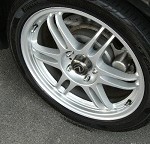
 This is the third in a series on how wheel choice can affect your car's performance.
Should you fit 14s, 15s, 16s, 17s, 19s, 22s? This article will help you decide what size is right for you.
I've been working on debunking some long standing myths in this series and if you missed last week or the week before, I recommend that you check those out as well:
Last week I explained how changing wheel width too much on a street car can change your car's handling at the limit and how it can actually make for some dangerous situations in the more extreme cases. We discovered that wider wheels do not always (and in most cases never) increase the car's ability to grip the ground in the corners and how wider tires do not necessarily put more rubber on the ground.
Fortunately, while wheel width is limited by suspension geometry, wheel diameter can be whatever you like, as long as it fits and you're willing to accept certain trade offs. But before you go thinking it's a total free for all, let's talk about the ways wheel diameter affects your car's performance and the trade offs you make, especially when going larger.
The trade offs with bigger wheels are: (in no particular order) reliability (resistance to bending), slightly changed center of gravity, increases in power required to turn the wheels, harder steering effort in non-PS vehicles, possible decreases in cornering performance, added expense, ride quality suffers, and possible gearing change.
The upsides are fewer but pretty obvious and rather important to some enthusiasts: looks, better stability during spirited driving (sidewall temperatures do not soar) and the ability to fit over larger brake rotors.
Sizing
When selecting a wheel/tire combo, you should always select the size with the closest to factory overall wheel/tire diameter, regardless of the rim size. You can use a calculator like this one to calculate the difference in overall diameter from your stock wheel to the new one. Within 0.8% is good, I like to stay with 0.3% or less whenever possible.
The tire size you use with whatever wheel diameter you pick can be messed with a little bit to achieve the right overall diameter.
Tire sizes are usually given like this: 215/45/17. What this means is that the tire is 215mm wide, the sidewall is ~ 45% of the 215mm width and the last number is the rim size the tire is for. If you want more information on tire sizing and specifically decoding tire sizes on tires, check this link.
Sidewall & Overall Size Considerations
With wheel diameter increases come a decrease in sidewall size in order to maintain the same overall tire+wheel combo size. It's important to stay as close to the stock tire+wheel combo size as the overall wheel size affects gearing.
Smaller wheels improve acceleration at the expense of top end, and taller wheels decrease acceleration while theoretically increasing top speed (though in practice top speed is limited by power and drag long before tire size. Increasing tire size usually also hurts top end acceleration and top speed as it decreases the engine's ability to overcome the air drag holding the car back). There will also be changes in your speedometer reading in most cars with different sized wheels.
In any case, making the overall wheel/tire combo taller or shorter will again affect suspension geometry. You can change it a small amount without any real adverse effects but try to stay as close as possible when choosing a new size.
The big "gotcha" with sidewall size is that the smaller the sidewall, the less protection your probably expensive rims will have from the inevitable pothole or road debris. You can run lower profile tires with stronger wheels, but in general the stronger the wheel, the heavier it is as well.
I assume most of you are running fairly lightweight aluminum wheels that while strong, will not do well with less than a 45 section height against road imperfections. The sweet spot in my experience is to aim for a tire between a 40 and 55 section height. If you are running a 60 or higher section height, you'll have a great ride but you'll have odd handling at the limit due to excessive tire sidewall flex.
You'll also probably experience premature failure on a road course due to excessive temperature in the tires from all that sidewall flex. If you're running 40 and lower, you'll have a very rough ride and be prone to bending rims.
From all the experts I've talked to, it seems that around the 45 sidewall size is the best all around. You'll find this is a very popular size with modern cars (especially since the trend has been towards larger and larger wheels on factory cars). This means these tires will usually be reasonably priced and have a lot of available treads and compounds to choose from. Avoid "weird" sizes as they're expensive and you'll have few choices in performance rubber.
Small sidewalls are very stiff, great for cornering "feel" but terrible for ride quality and straight line stopping and acceleration (more on that later). Stiffer sidewalls do not give any additional grip.
As the sidewall size goes down, the weight of the tire stays the same or gets bigger.
However, as a result of an increase in wheel diameter, this makes the weight distribution of the wheel+tire combo worse - the heaviest part (the tire) is now further away from the center of the wheel - refer to Part I for why that's bad. In short, it robs precious power from getting to the road. Many guys spend so much time focusing on the wheel weight but never even think about the tire weight and its effect on the weight distribution of the wheel.
Warning: Never make the mistake of choosing a TIRE by its weight. Usually a tire's weight is directly proportional to how much reinforcement is inside the tire. Cheap tires are often lightweight, but only because they cheeped out on the sidewall reinforcement. I actually had a popular cheap tire go out of round because it was so cheaply made inside. Choose tires based on tread and compound - never by weight. DO consider the weight of the tire when picking the size of your wheel, however.
Larger sidewalls allow better ride quality, better straight line launch, braking and do not necessarily decrease grip but may make the car handle less precisely. In other words, the sidewall flexes so the steering response will be slower and you get a lot more "roll" in the bends. Too big of a sidewall can cause excessive tire temperatures due to a lot of flexing about and possible failure in race conditions so it still is ideal to keep relatively low profile sidewalls on performance applications as we mentioned earlier.
You'll notice that drag racing slicks always have very tall sidewalls. You never see low profile drag slicks. This is because when a drag car launches, the tire actually deforms and ripples up to create an even fatter patch of rubber on the ground and to generate 'bite' into the ground. The smaller the sidewall you use, the more likely you will spin your tires off the line. Taller sidewall tires can generally bite harder both under braking and acceleration.
If you're looking to fit wheels that weigh less than stock, the larger you go in diameter, the more difficult and expensive it will be to find a lighter than stock wheel.
For Project Lexus, which I'll be posting about later on, I chose to stick with the factory diameter of 17 inches since it already had a 45 section height tire. The factory wheel weighed in at roughly 22 lbs and we were able to find a replacement wheel, the Kosei KS T1 weighing in at only 14 lbs. I replaced all 5 wheels including the spare, losing about 40lbs in the process. 32 lbs of that was unsprung, rotational weight as discussed in section 1 of this series. I noted a small gain in city gas mileage (1 mpg on average), faster acceleration and a better ride.
Acceleration actually was measured between 35-60mph and showed a repeatable and respectable improvement of just under 2 tenths of a second.
These wheels are just one of many lightweight wheels available in various sizes.
On some past Civic/Accord project cars, these cars tend to have very tall sidewalls. I have typically gone up to 15s or 16s on older Hondas to get to the 50ish sidewall height. For the new model Civic, a great upgrade for the non-Si models is to go for the Si or OEM optional sized wheels. The Si model actually already has the ideal size for the suspension.
In closing, check out the PDF at the end of the last part of this series (Part II). There's some interesting tid bits in there about how running a lower profile tire actually affects center of gravity height. Granted, for most cars this change would be insignificant compared to an SUV. It's interesting despite not being terribly relevant for most of my audience
Please be sure to post your comments and your questions, maybe some of them will inspire an article next week.
In the mean time, have a great weekend everyone, share articles with friends, comment and ask questions and I'll see you back on Monday for another week of tech.
Extremely Limited Time Offer - 3 Days Only
Get a MASTERS DEGREE in Performance Tuning from the BEST in the Field for ONE low package price




For 3 days only, get ALL of our PREMIUM (not available anywhere else) Tuner University Courses featuring some of the greatest minds in motorsports:
- Top 10 Performance Myths Class (MP3 and Edited Transcript) - $29.95 value
- Performance on a Sip of Fuel Class (MP3 and class manual) - $69.95 value
- Header Design Secrets with John Grudynski (MP3 and transcript) - $69.95 value
- Dirty Secrets of Oil with Ryan Stark (MP3 and transcript) - $69.95 value
- Engine Tuning Secrets with Ben Strader of EFI University (MP3 and Transcript) - $69.95 value
Get all of the above courses (many of which not currently available anywhere else) for one single price of just $309.75 $69.95. A HUGE package savings.
You can also buy any of these individually through our resource center, but I don't know why you would as this is basically the whole store for the price of just 1 course. You'll get the MP3 recordings of each class as well as a transcript or companion manual with each course and you'll be able to download them all INSTANTLY.